




Policy Support + Technological Breakthrough: A Case Study of Chinese Bakery Equipment Manufacturers’ Shift to Turnkey Production Solutions
From Automated Production Lines to Smart Factory Turnkey Projects: Yufeng Machinery Explores a New Path for Chinese Bakery Equipment to Go Global
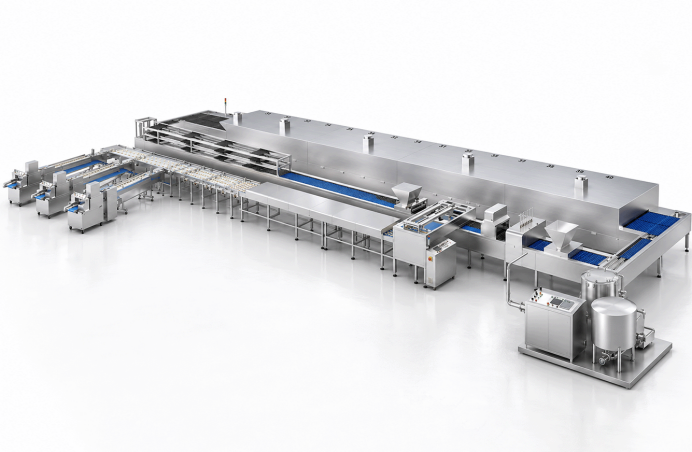
In 2024, Shantou Yufeng Machinery Co., Ltd. delivered a fully automatic cake production line to a customer in Indonesia. After the line had operated reliably for one year, Yufeng Machinery recently reached an agreement in principle with the customer on a second-phase expansion, and design work for a new smart upgrade solution has already begun. The production line covers the entire process, from raw material handling to finished-product packaging. From the delivery of the first phase to the launch of the second-phase expansion, the partnership is evolving from a “one-time purchase” to “continuous optimization and iteration.”
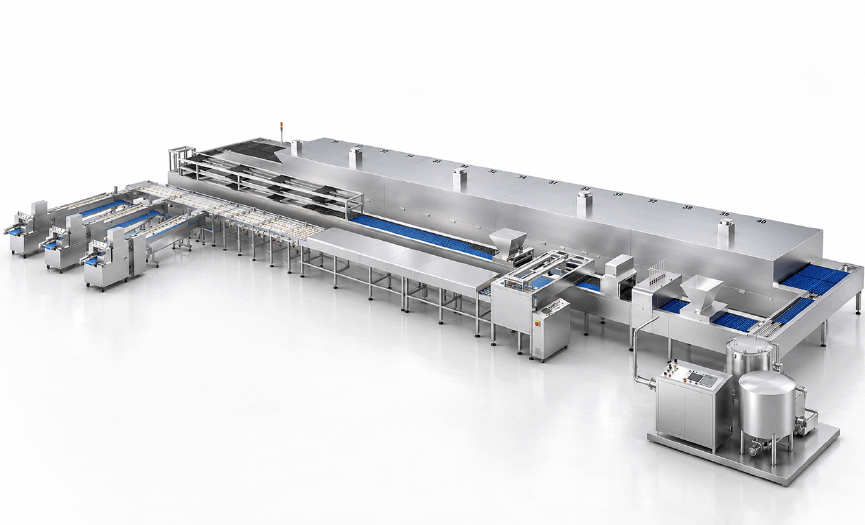
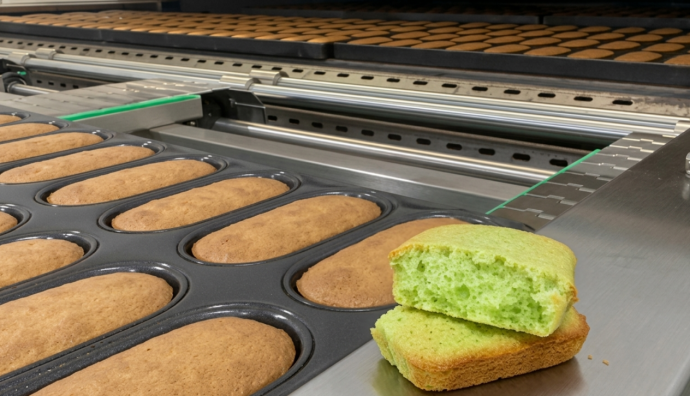
The production line is not simply an assembly of individual machines. Instead, it represents a systematic redesign centered on the complete cake manufacturing process. The solution covers key stages including raw material storage; refrigerated egg storage, washing and automatic handling; ingredient dosing and flour sifting; continuous aeration and whipping; automatic depositing and forming; tunnel baking; controlled-air cooling; sterilization; and automatic packaging. The complete line is planned for a daily production capacity of 24 tonnes, with the aim of meeting overseas food manufacturers’ requirements for standardized and large-scale production through a fully automated, closed-loop process.
From “Equipment Manufacturing” to “Production System Design”
In 2025, seven government departments, including the Ministry of Industry and Information Technology, jointly issued the Implementation Plan for the Digital Transformation of the Food Industry (MIIT Consumer Affairs [2025] No. 129), explicitly calling for deeper integration of next-generation information technologies with the food industry. Against this backdrop of industrial upgrading, the competitive landscape of the food equipment sector is undergoing a profound transformation: companies must not only be capable of manufacturing machinery, but also understand production processes and system integration, enabling them to provide manufacturing solutions covering the entire production workflow.
Inside its production facility in Shantou, this company, founded in 2012, is preparing batches of bakery equipment for shipment to overseas markets. Initially, its business was built around automated production lines. Today, as overseas food manufacturers demand higher levels of efficiency, reliability and production management, the company is extending its capabilities toward intelligent and digital manufacturing, gradually developing service capabilities spanning individual equipment, complete production lines and overall factory planning. This evolution is aligned with the broader policy direction of digital transformation in the food industry.
“Ten years ago, customers would ask, ‘How much does this mixer cost?’ Today, they ask, ‘I have five supermarket locations and want to sell cakes. Can you help us plan a central bakery facility?’” The company’s head described the change in customer requirements to the reporter. “This means we are no longer selling pieces of machinery. We are providing an end-to-end planning and manufacturing solution that customers can rely on.”

A Cake Production Line Is Built on System-Level Planning
The TA Series fully automatic cake production line planning project for Indonesia demonstrates the transformation of food equipment manufacturers from “equipment manufacturing” to “production system design.”
Based on the customer’s production requirements, the company systematically planned the entire line around the cake manufacturing process. By coordinating and automating the connections between different production units, the manufacturing process is shifting from isolated machine operation to continuous and intelligent production.
For bakery manufacturers, the core of intelligent and digital production is not simply adding more equipment, but enabling different stages of production to work together, thereby improving process stability and controllability.
According to the company’s R&D lead, food production involves multiple critical parameters, including temperature, speed and formulation. Only by integrating equipment, process know-how and data can manufacturers genuinely help customers improve their production management capabilities.
Over the past five years, the company’s annual R&D investment has grown by more than 20% on average, while the proportion of R&D personnel has increased from 15% to 30%.
Alongside continued product development, the company has also actively participated in industry technology development. It contributed to the formulation of the national standard for “Dual-Arm Composite Robots” and related projects under China’s 13th Five-Year Plan for national mechanical industry standards, strengthening the foundation for independent equipment R&D through accumulated technical expertise.
From Automated Equipment to Intelligent Manufacturing Systems
As the digital transformation of the food industry enters a deeper stage, the competitive logic of global equipment manufacturing has fundamentally changed. Competition is no longer limited to individual machines; it is increasingly shifting toward production systems and integrated solutions.
In response to this trend, the company is accelerating the integration of advanced technologies such as AGVs/AMRs, robotic arms and machine vision into its production equipment. These technologies give production lines the ability to perceive and interact with the physical environment, driving the transition from simple “automated operation” to intelligent systems capable of “perception–decision-making–execution,” and further toward more efficient, coordinated and digitally intelligent production systems.
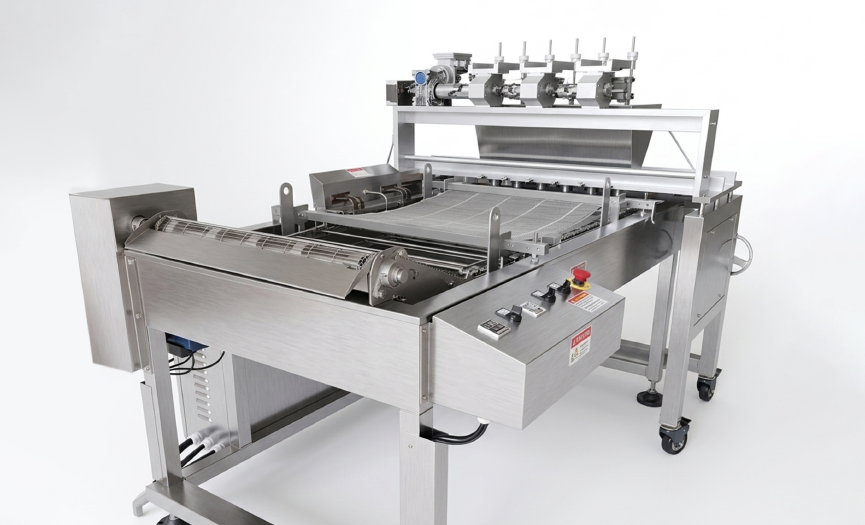
Inside the company’s assembly workshop in Shantou, an automatic batter depositing machine equipped with machine vision is undergoing pre-delivery commissioning. Sensors monitor batter flow in real time, and an automatic alarm is triggered when deviations exceed the preset threshold. This is a representative example of how the company is integrating Internet of Things technologies into traditional bakery equipment.
In recent years, the company has incorporated AGV automated guided vehicles, robotic arms and related intelligent and digital systems into its production-line designs. In the Indonesian project, for example, operating data from the entire line is transmitted in real time to a central control system. Managers can remotely monitor parameters such as temperature and speed across different processes, enabling a shift from “people monitoring machines” to “data managing the production line.”
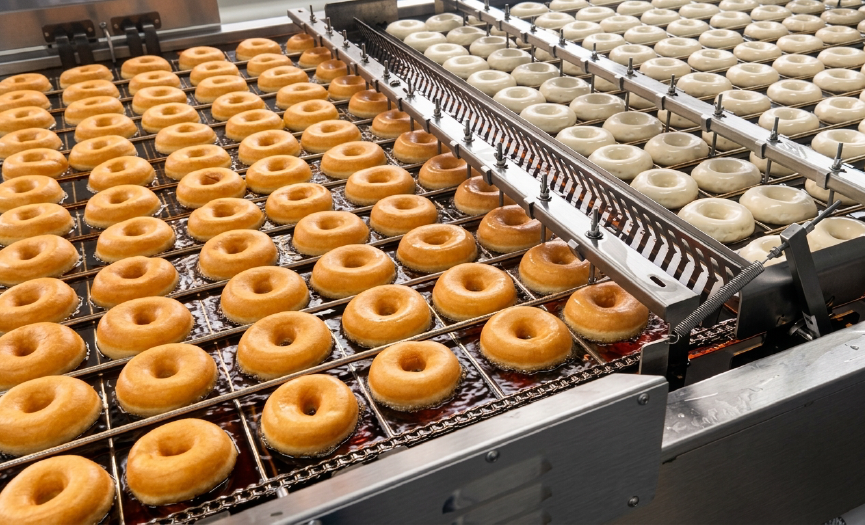
“In the past, one production line required 15 workers to monitor it in shifts. Today, the status of the entire line can be monitored through a central control dashboard,” the head of the company’s technical department told the reporter. At present, its donut, cake and frozen pastry production lines have adopted modular designs, while the proportion of independently developed core components continues to increase.

From “Product Export” to “Solution Export”
In the past, Chinese equipment manufacturers often entered overseas markets primarily through cost-performance advantages. Today, overseas customers are increasingly focused on whether manufacturers can provide customized, intelligent and digital end-to-end solutions tailored to their specific needs.
From automated production lines to intelligent and digital upgrades, and from equipment delivery to integrated solutions, the competitive logic of Chinese bakery equipment manufacturers is changing. This may well represent a microcosm of the broader transformation of Chinese manufacturing—from the dividends of scale to the dividends of technology.
As the Implementation Plan for the Digital Transformation of the Food Industry sets the goal of significantly increasing the rate of numerical control in key processes among food enterprises above designated size by 2027, the food equipment industry is entering a new window of opportunity for upgrading.
Chinese food equipment manufacturers are moving from “product export” toward “solution export.” Behind this cake production line connecting China and Indonesia is not only a connected production process, but also a reflection of the broader transition from “Made in China” toward “Intelligent Manufacturing in China.”