


A Revolution in Thermal Efficiency for Donut Fryers
A group of customers from the United States visited Yufeng’s workshop. They spent quite some time examining a donut production line. When their attention turned to the fryer’s heating system, one of them stopped to take a closer look.
“Is this an external heating system?”
When we confirmed that it was, he nodded. “This is a good solution. The oil is heated externally and then circulated back into the fryer. The bottom of the frying tank stays clean, and the system is both energy-efficient and easy to clean. Our direct-fired fryers consume a lot of gas, and we have to stop production whenever the tubes need to be removed and cleaned.”
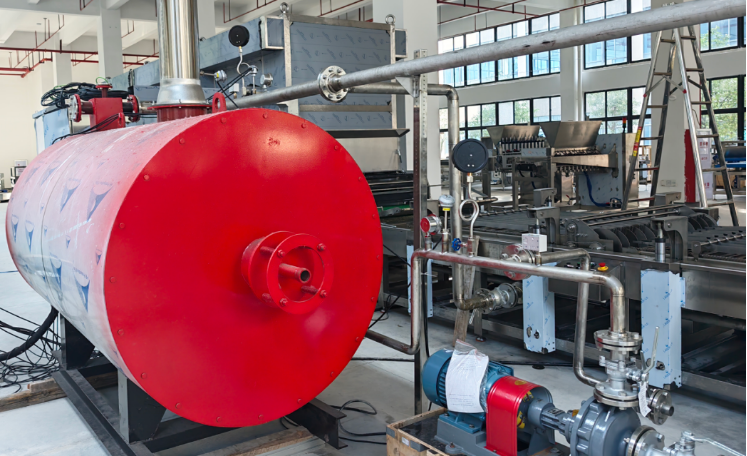
For the technical lead standing nearby, the reason was clear. This was exactly why the team had spent months upgrading the heating system across its donut fryer range from direct-fired heating to an external coil-type system.
Why Make the Switch from Direct-Fired to External Heating?
In Europe and North America, gas-fired direct-heating fryers have long been a mainstream choice for industrial donut production. A row of burner tubes is installed at the bottom of the frying tank, with flames firing directly into the tubes and transferring heat to the oil through their walls.
“The tubes are about four centimeters in diameter and 1.4 meters long. The flame fires directly into one end and the exhaust exits at the other,” the technical lead explained. “Exhaust temperatures can reach 300–400°C, meaning that around 50% of the heat is lost.”
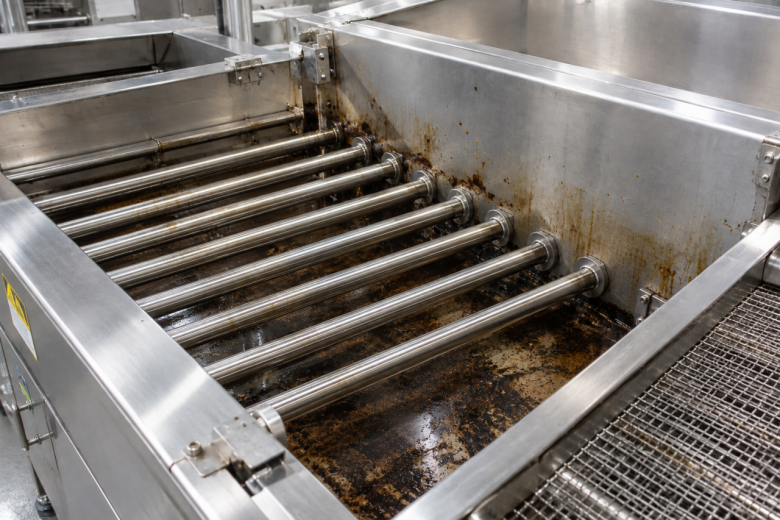
Energy consumption is only part of the problem. With the direct-fired tubes positioned close to the bottom of the tank, oil temperatures near the burner outlets can become extremely high. This localized overheating accelerates oil degradation and carbonization. As a result, donuts may fry unevenly in color, with areas near the burner outlets becoming excessively dark and developing a bitter taste. Over time, residue also builds up around the tubes beneath the tank, making removal and cleaning a difficult task. The oil deteriorates faster, requiring more frequent replacement and adding further operating costs.
“This is one of the biggest headaches for customers,” he said. “When frying donuts, the color and quality of the oil have a direct impact on the appearance of the finished product. Once the oil begins to burn and degrade, the donuts can develop a burnt taste and a darker color. Customers simply won’t accept that.”
Low thermal efficiency, unstable temperature control, difficult cleaning, and faster oil oxidation and degradation—all of these translate into real monthly operating costs for factories in Europe and North America.
The Customer Benefits Behind 92% Thermal Efficiency
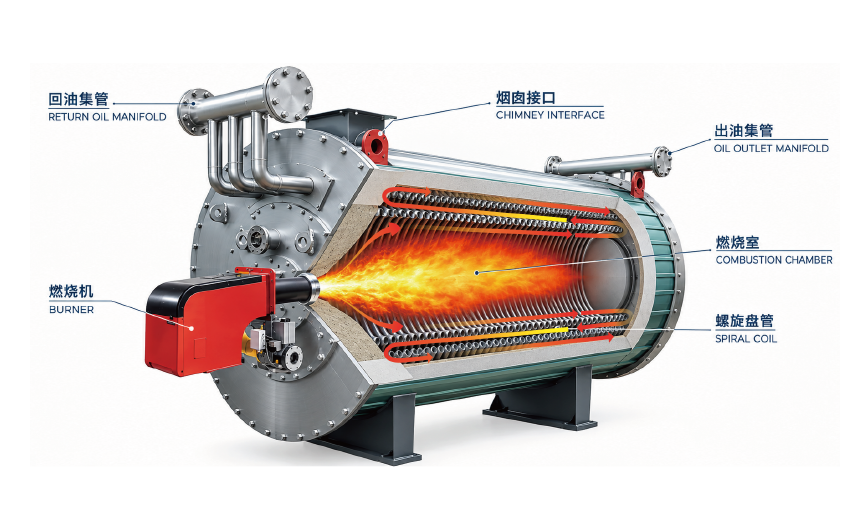
The upgraded external coil-type fryer heating system moves the burner completely outside the frying tank. The principle is straightforward: the burner ignites externally, and the high-temperature flue gas enters a sealed coil chamber, where it travels through two layers of coils in an S-shaped, multi-pass path. This allows heat to be transferred efficiently to the oil before the cooler exhaust gas is discharged. The oil is heated in the external unit and then circulated back to the fryer.
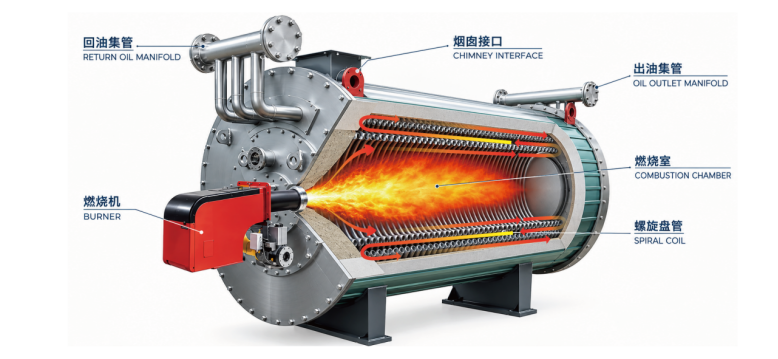
Thermal efficiency rises from less than 50% with conventional direct-fired heating to more than 92%.
The larger heat-transfer area allows far more of the heat to be retained by the oil. Exhaust temperatures are significantly reduced, while the oil is heated more evenly. Donuts therefore achieve more consistent color, helping improve product yield.
What Customers Save Goes Straight to the Bottom Line
Numbers may seem abstract, but every percentage point represents real money.
What does 92% thermal efficiency mean in practice? For a factory producing tens of thousands of donuts a day, the difference in fuel consumption adds up month after month. Reducing exhaust temperatures from 300–400°C to a much lower operating range means more heat stays in the system instead of being wasted into the surrounding air.
Even more important is stable oil temperature. Combined with a modulating automatic control valve, the external heating system offers a temperature-setting resolution of 1°C, enabling precise control at both high and low fire. Oil-temperature fluctuations are kept to a minimum. More stable oil temperatures can extend the oil replacement interval by 30% to 50%, delivering tangible savings in operating costs.
Another benefit is easy to overlook: there are no heating tubes inside the frying tank itself. With no direct-fired tubes beneath the tank, there are fewer hard-to-reach areas where residue can accumulate. Routine cleaning becomes much simpler for operators. This was also what stood out to the American customer: “Unlike our direct-fired fryers, the tubes in this system don’t discolor through prolonged heating or become difficult to clean because of built-up deposits.”
Intelligent Control: Making Safety the Default
Improving heating efficiency is only the first step. What gives overseas customers real confidence is the brain of the entire system: the intelligent control cabinet.
Many overseas customers report that recruiting and retaining skilled operators can be difficult, and workers may not always be familiar with the equipment. Yufeng’s control-cabinet design follows a simple principle: make operation easier and safety more reliable.
When the system is powered on, a welcome screen appears on the touchscreen. The main menu provides a clear overview of operating conditions, including oil temperature, pressure, differential pressure, and flue-gas temperature. Based on the oil outlet temperature, the controller automatically determines whether the burner should operate at low fire, high fire, or shut down completely. The circulation pump runs automatically, while the oil-filling pump starts and stops according to the oil level. Operators only need to set the upper and lower limits.
What truly reassures customers, however, is the system’s seven-level interlock protection.
If the outlet temperature becomes too high, the burner is shut down automatically. The same applies if the flue temperature becomes abnormal. Other monitored conditions include excessive pressure, insufficient differential pressure, abnormal gas pressure, sensor failure, and burner flameout. Whenever an abnormal condition occurs, the system immediately cuts off the heating unit, displays an alarm on the screen, and activates audible and visual alerts. If power is interrupted and then restored, the controller returns to a safe state and does not restart automatically.
Operating records, fault statistics, and temperature curves are all saved automatically. This is more than a machine that simply runs—it is a system that records, alerts, and protects itself.
Thoughtful Engineering in the Machine’s ‘Body’ Makes Operation Easier, Too
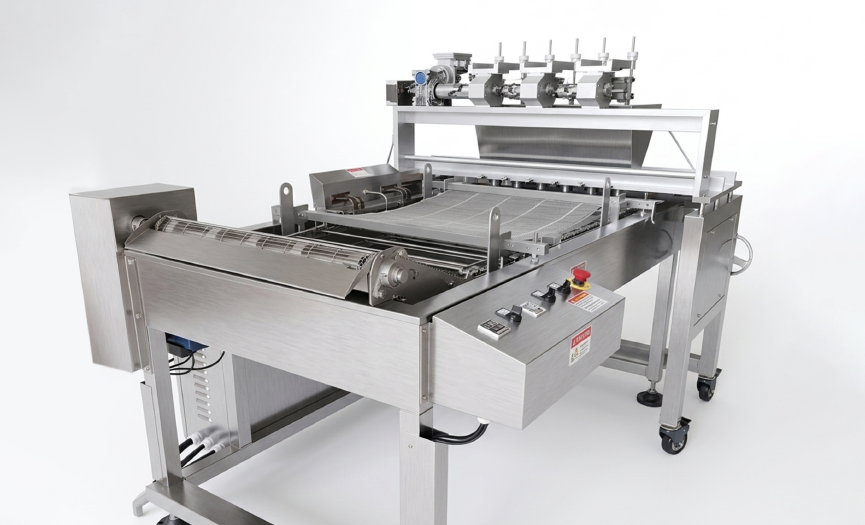
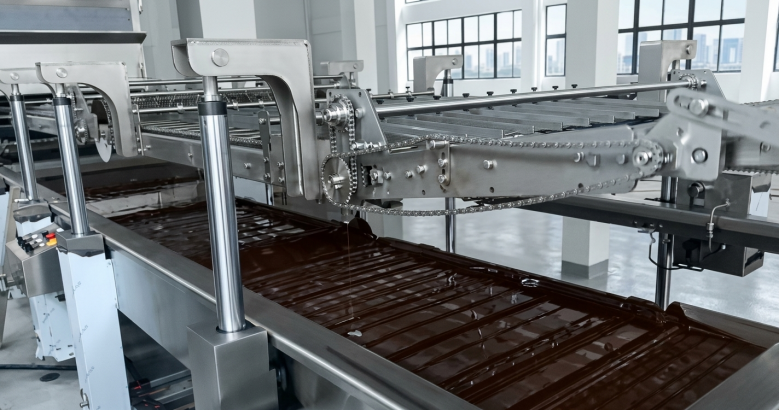
To address the weight of conveyor systems on large industrial fryers and the limited space available for maintenance, Yufeng has integrated the lifting mechanism directly into the machine. Earlier versions used a hydraulic system, but the hydraulic power unit was large and complex. The latest generation has been upgraded to an electric cylinder with a screw drive: a motor drives the screw and nut assembly to raise the conveyor smoothly.
This change eliminates the need for a bulky external gantry, creating sufficient clearance for the fume hood to be installed lower and significantly improving the collection of cooking fumes. Once the conveyor is raised, operators can also access the inside of the fryer and the area beneath the conveyor more easily for cleaning and maintenance—without spending excessive time trying to reach awkward corners.
Customer Needs Remain the Starting Point for Every Upgrade
From customers in the United States to visiting delegations from Latin America and factory owners in Southeast Asia, customers who have seen this external fryer heating system have responded with remarkably consistent enthusiasm. They are familiar with the drawbacks of direct-fired tubes: exhaust pipes that become dangerously hot, hours of downtime to remove and clean tubes beneath the tank, and fluctuating oil temperatures that cause donuts to vary in color from batch to batch. When they see the external coil-type solution, many recognize that a long-standing problem has finally been addressed—and that confidence has helped turn interest into orders.
Taken together, this feedback points to one common priority: reducing costs. Higher thermal efficiency saves fuel. Stable oil temperatures and longer oil replacement intervals reduce oil costs. A tube-free frying tank and simpler cleaning reduce downtime and labor. The intelligent control cabinet also reduces the need for operator training. Every technical improvement ultimately makes a difference on the customer’s operating-cost sheet.
The donut production line is just one part of Yufeng’s broader product portfolio, but it illustrates an important shift: China’s food-processing equipment industry is moving beyond exporting products on the basis of cost competitiveness and toward delivering technology-driven solutions. The measure of a good solution is straightforward: it helps factories reduce their operating costs and ensures that every investment delivers a visible return.