

Hot Products
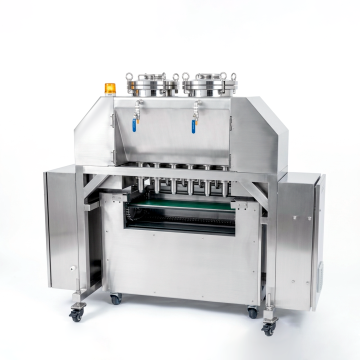


China Factory Suppliers - CAF Series Depanner and Demoulding Machine for Cakes, Croissants, and Pies
Three Types of Depanner Machine
DMA
Moving Head Slides
Equips with a motorized moving head slides. According to the products, it is possible to use heads with suction cups or needles. For different size products, the depanning plate is easily interchangeable. For high speed needs, the machine can be supplied with servo motors.
DMB
Overturning System
Overturning the baking trays to take off the products. It includes a frame, a conveyor for overturning the trays, and a conveyor for transferring the products.
DMC
Robot Arm
Equips with a robot arm. It adopts computer programming. The range of modular product transfer systems provides accurate and controlled handling, ensuring the highest quality of the final product.
Specification
| Parameter | Details / Value |
|---|---|
| Model | DMA |
| Depanning Speed | 4-6 times/min (1-2 trays/time) |
| Voltage and Frequency | 3 Ph, 380V, 50Hz (Optional) |
| Power | 2.5kW |
| Dimension (L*W*H) | 2050*1800mm (length depends on conveyor) |
| Air Pressure | 0.6-0.8MPa |
| Maximum Air Consumption | 0.4m³/min (external gas source) |
Maintenance and Support
1
Preparation
Make sure the depanner is in a stable position and connected to the power or air supply. Check the cleanliness of the depanner and ensure that the machine is operating normally.
2
Set up the depanner
Adjust the device of the depanner as needed to ensure that it can adapt to the size and shape of the cake mold plate to be processed.
3
Start the depanner
Start the depanner according to the operating instructions of the machine. This usually involves starting the motor or air compressor to start the depanner device or conveying system.
4
Depanner operation
The depanner will automatically remove it from the mold plate through the depanner plate. Ensure that the depanner process is smooth to avoid additional impact or damage to the cake.
5
Remove the cake
When the cake is removed from the mold and safely transported to the designated location, the depanner will place it on the corresponding workbench or conveyor belt.
6
Inspection and adjustment
Inspect the removed cake to ensure its integrity and good quality. Make necessary adjustments and corrections as needed.
7
Cleaning and maintenance
After use, clean the depanner device, workbench or conveyor belt to ensure that there is no residue. Regularly perform maintenance and care of the stripper, such as lubrication, cleaning, and inspection of electrical components.
Note: The operation of large depanners generally requires an experienced operator to ensure efficient and safe operation. The conditions of each baking facility may be different, so the operating steps and precautions should be adjusted according to the actual situation.
Product Gallery


Frequently Asked Questions
What are the three main types of depanner machines?
The three main types are: DMA (which equips with motorized moving head slides using suction cups or needles), DMB (which overturns the baking trays to remove products), and DMC (which uses a programmable robot arm system for high accuracy).
What is the depanning speed of the DMA model?
The DMA model features a depanning speed of 4 to 6 times per minute, handling about 1 to 2 trays per cycle.
What are the power and voltage specifications for the DMA depanner?
The DMA model operates with a power of 2.5kW and supports a voltage and frequency of 3 Phase, 380V, 50Hz (with customization options available).
What is required to operate a large-scale depanner machine safely?
The operation of large depanners generally requires an experienced operator to ensure efficient and safe operation. Operating steps and precautions should always be adjusted according to the actual situation of each baking facility.
What routine maintenance does a depanner machine require?
Routine maintenance involves cleaning the depanner device, workbench, and conveyor belt after use to eliminate residue. Regular care includes lubrication, thorough cleaning, and periodic inspection of electrical components.